Argentine tangoGuide
How to Count Argentine Tango: The Walk and the Eight Count Basic
Argentine tango is taught with an eight count basic, but the numbers name places in a figure, not beats in the music. How to count the walk and the music.
5 min readWritten at Count Studio
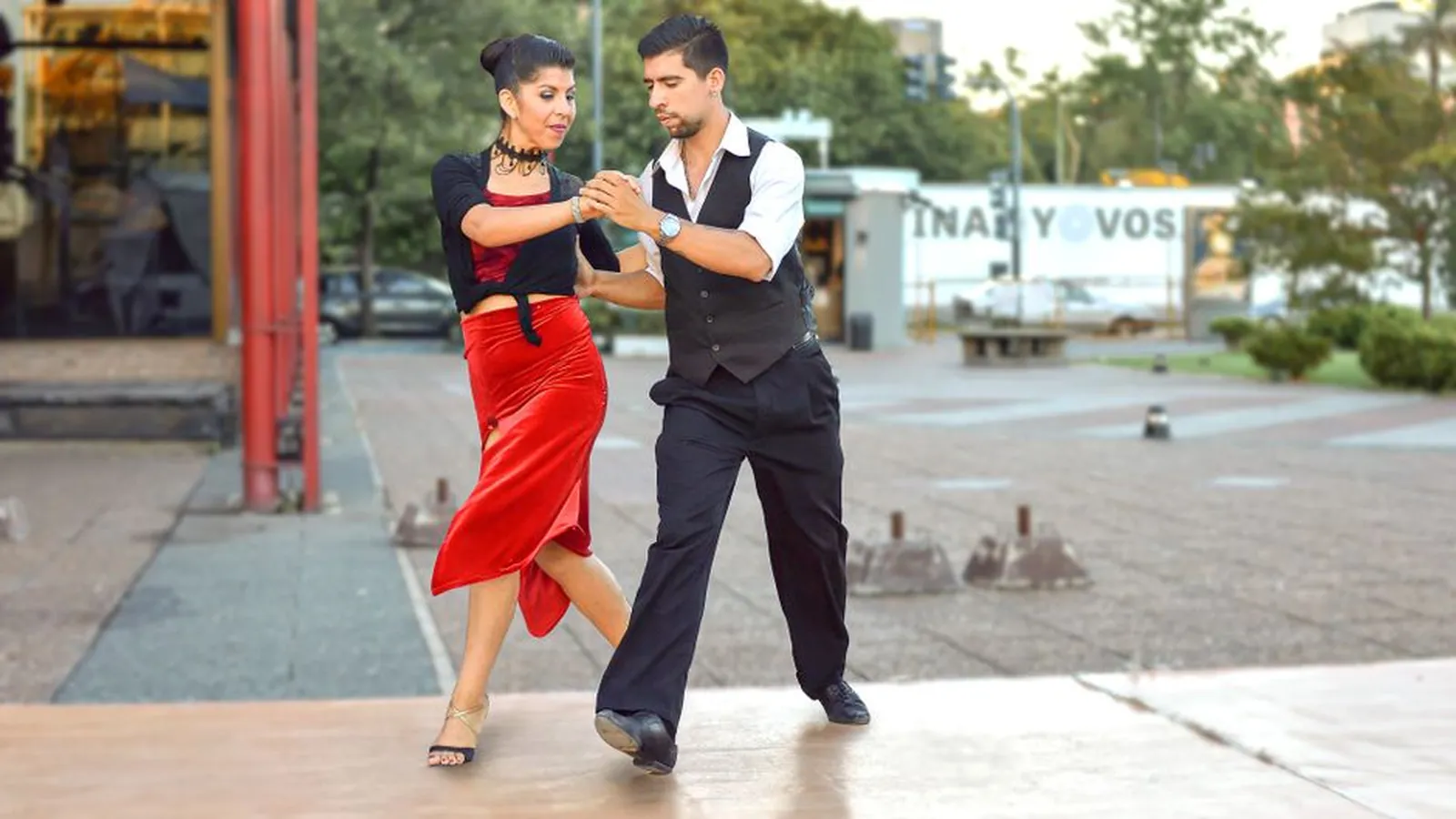
Ask three tango teachers how to count Argentine tango and you may get three answers. One will hand you the numbers 1 to 8. One will tell you to stop counting and listen. One will have you walk. All three are right about something, because "the count" in tango means two different things: the numbered positions of a teaching step, and the beat of the music underneath it.
This guide keeps them apart. You'll learn what the eight count basic numbers mean, how to find the pulse in a recording, and where milonga changes the rules. If you are new to the idea of counting in eights, start with what an 8-count is, then come back to Argentine tango.
How to count Argentine tango: the short answer
Count the music in two strong beats to the bar, "1 2, 1 2", and walk with it. When a class teaches the eight count basic, you count its positions "1 2 3 4 5 6 7 8": back step, side step, the follower's cross, a forward step and a side step. Those eight numbers are places in a figure. They are not eight equal beats you will hear in the song, and the basic itself is, in the words of its Wikipedia entry, used for education and almost never danced as the basic step of tango.
Step by step: the walk and the eight count basic
Begin with the walk, because everything else is built on it. Stand in a relaxed hold, or just alone, and take a step to each beat of a recording. That is a drill, not a rule: tango has many rhythms, and good dancers pause and double up. Still, walking one step to a beat teaches you to tell the pulse from the melody.
Then add the figure. The eight count basic is made of a back step, a side step, a cross for the follower (the leader steps outside the partner with the right leg), a forward step and a side step. The positions are numbered, with 0 for the closed position at the start, and they fall into four phases:
| Phase | Positions | What happens |
|---|---|---|
| Salida (the start) | 1 and 2, plus the move to 3 | Back step, then a side or open step |
| Caminata (the walk) | 3 and 4 | Walking steps |
| Cross | 5 | The follower's cross |
| Resolution (the end) | 6, 7 and 8 | A walk, a side step to the right, a weight change |
Say the numbers out loud as you step: "1, 2, 3, 4, 5, 6, 7, 8". That is the eight count basic's count, and it works as a map of the figure. The source describes position 1, the back step, as part of the salida and not used in social dancing, which tells you how much of a teaching tool this is. Position 8 is a weight change in place, a cadencia, so you can finish a step without moving across the floor.
One honest limit: the source names the positions but does not say how each one is timed against the music. Your teacher will tell you whether a step is a full beat or a half. Ask, and write it next to the number.
Find the 1 in the music
The music tells you where to step. According to the Argentine tango article on Wikipedia, the music typically has a 2/4 or 4/4 time signature, built on the "dos por cuatro" idea of two strong beats on four, with a clear, repetitive pulse. In plain terms, you can tap your foot twice per bar and feel the strong beats land.
Two things help you find them.
First, listen to the bass or the low strings. The pulse is usually plain there even when the melody is busy. If you need a method, find the 1 in the music walks through it for any song.
Second, listen for sections. Pieces are built from two or three parts that repeat in patterns such as ABAB or ABCAC, per the same entry. When the music moves from A to B, the feel often changes, and that is a good moment to change what you are doing. The dance orchestras Di Sarli, d'Arienzo, Troilo and Pugliese each phrase these sections differently, which is why the same figure can feel lighter or heavier from one recording to the next.
Don't hunt for a tempo number. The Wikipedia entry on Argentine tango gives none, and orchestras vary. Tap along to the track in front of you instead.
Common problems
Treating the eight numbers as eight beats. This is the most common mix-up. Counting "1 to 8" in a figure feels like counting 8 beats in a bar of music, but in tango those are positions in a figure. If your steps feel rushed or heavy, check you are listening to the pulse, not chasing the numbers.
Rushing the walk. When you are nervous, the steps speed up. Go back to one step per beat of a slow recording and keep the count in your body, not in your head.
Counting milonga like tango. Milonga is faster, and its music is syncopated. According to Wikipedia's milonga entry, each phrase has 8 counts, and the main accent usually falls on the first count, sometimes the second, with more accents on four, five and seven. In milonga lisa you step on every beat. In milonga con traspié you add quick weight changes, three steps in two beats. The basic of milonga is a six-step figure, the baldosa (tile) or cuadrado (square), which is like the eight count basic without the cross. If you are used to triple-feel dances, how to count waltz shows a different way to count a bar of three.
Counting forever. The numbers are for learning. Once the walk is steady, let the counting drop away and follow the music.
Practise it with Count Studio
A short drill: pick one recording, tap the pulse with your foot for a minute, then walk it for a minute, then add the eight count basic and say the positions out loud. Repeat at a slower speed if the walk slips. Do the same with a milonga to feel the difference.
Count Studio has an Argentine tango pattern in its count library, a tempo range from 20 to 320 BPM, and tap tempo to match the track you are practising to. It is coming November 27 to iPhone, iPad and Apple Watch.
Bottom line
Argentine tango has two counts: the positions of the eight count basic, and the pulse of the music. Learn the numbers as a map, walk the beat to build the pulse, and let the music decide the rest. Milonga keeps 8-count phrases, but its accents and speed are its own.
Questions
Is Argentine tango counted in 8?
Teachers use the eight count basic to teach it, with positions numbered 1 to 8. It is a teaching step, almost never danced as the basic step socially, so the numbers name places in a figure rather than a count you hear in the music.
What time signature is Argentine tango?
The music typically has a 2/4 or 4/4 time signature with a clear, repetitive pulse. Either way, you can feel two strong beats to the bar.
Is milonga counted the same as tango?
Not quite. Milonga music is syncopated and its phrases have 8 counts, with the main accent usually on the first and more accents on four, five and seven. It is danced faster than tango.
Do I need a tempo in BPM to practise?
No single number applies to every tango, because orchestras differ. Tap along to the recording you will dance to, practise the walk slower than the music, then match it.